1687 Bruner Family Privilege
La piel del tamborThe 1687 Bruner Family Privilege is the condition attached to Gaspar Bruner de Lebrija’s gift of land for Nuestra Señora de las Lágrimas: Mass must continue to be said for his soul, and the church retains its rights while the condition is observed. Centuries later, that obligation is no mere relic. Its weekly repetition gives the Bruner family a claim in a struggle over demolition and redevelopment, making an act of worship both a living ritual and a point of institutional leverage.
Origin and Terms
The family’s connection to the church begins with Gaspar Bruner de Lebrija, a duke of the New Extremadura line. In 1687 he ceded land he owned for construction of the church on the condition that Mass be celebrated for his soul once a week. His son, Guzmán Bruner, paid for the completion of the altarpiece, which included images of his parents; the family also brought the Virgin’s image to the church in 1711. The foundation’s history is thus visible not only in a legal privilege but in the church’s devotional furnishings and dynastic memorials.
The obligation later acquired a specific weekly schedule: Thursday at eight in the morning, the day Gaspar was said to have died in 1709. The account links the privilege to the family’s influence and to a papal sanction granted in the same year as the original endowment. In the Archbishop’s explanation, the church keeps its privileges so long as Thursday Mass is said for its benefactor. The rule does not itself resolve every question of ownership, but it provides a practical barrier to secularization, the step required before demolition.
The Privilege in the Redevelopment Dispute
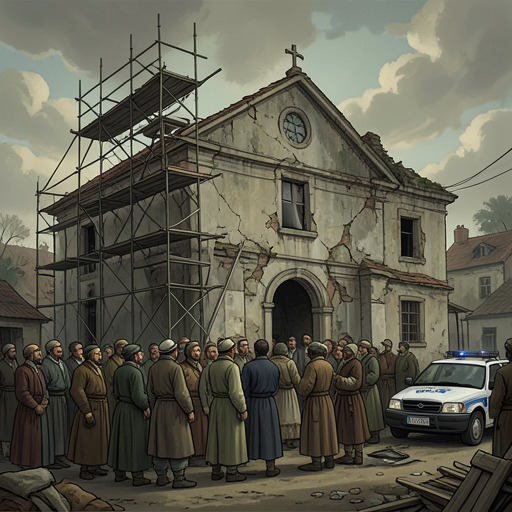
The property scheme around Nuestra Señora de las Lágrimas is nearly complete when the old family condition becomes a serious obstacle. Pencho Gavira’s plan has investment and institutional commitments behind it, but the 1687 document leaves open the possibility that failure to meet its terms could return the donated land to the Bruner family. A nineteenth-century law associated with Mendizábal’s confiscation of church property complicates the question further: if the church is secularized, the land would revert to Seville’s municipality. A Bruner lawsuit could therefore delay the project, even if it did not immediately settle ownership.
The Archbishop presents the matter as both a legal and financial problem. He says that the Archdiocese lacks a property right beyond the moral claim arising from three centuries of worship, while Banco Cartujano promises compensation, support for a new church in one of Seville’s poorest neighborhoods, and a foundation for social work among the Roma community. The proposal makes the institutional bargain sound beneficial, but the Thursday condition leaves the parish’s future dependent on a priest whose continued observance can frustrate the transaction.
The conflict is not simply between an ancient privilege and modern development. It also exposes divided authority. The Archbishop has requested Father Ferro’s suspension from office in Rome, but says the procedure is slow; he cannot prevent a parish priest from saying Mass. He distinguishes that limit of authority from a disciplinary dispute, since Ferro disregards pastoral instructions and calls to order. Meanwhile, the investigation has been assigned to the Institute for External Works, with Lorenzo Quart sent to Seville to identify the author of a letter and report discreetly. The local Archdiocese and Rome can each shift responsibility toward the other while the church’s status remains unsettled.
Thursday Mass as Enforcement
The privilege’s force depends on an act that must recur, not on the document alone. Each Thursday, an envoy of the Archbishop and a notary paid by Pencho Gavira watch the last row of the church for an irregularity or lapse. Their presence turns the service into a monitored legal performance: the parish must keep the condition, while its opponents wait for a mistake that could help clear the way for demolition. Macarena Bruner fears that, after Father Óscar is moved away, someone may try to compromise Father Ferro’s ability to keep the obligation.
Ferro does not merely satisfy the minimum weekly requirement. He says Mass every day at eight in the morning, and twice on Sundays and feast days. The Thursday rite is therefore embedded in a larger daily practice, even as it carries a special legal consequence. For Quart, the Mass reveals why the church cannot be understood only as a parcel in a development plan. He witnesses Ferro celebrating with old-fashioned vestments and Latin portions of the liturgy, before a modest congregation of parishioners; the rite provides comfort and community as well as preserving the condition that protects the building.
Legal Force and Limits
The privilege is powerful because it holds demolition at bay, but it is not an uncomplicated guarantee of the church’s survival. The development dispute involves secular property law, family claims, ecclesiastical discipline, and financial negotiations, none of which the weekly Mass alone settles. The Archbishop describes the project as stalled by Ferro’s persistence, while the Bruner family understands the same persistence as the safeguard keeping the church from the demolition crew. The opposing descriptions make the ritual’s institutional meaning explicit: one side sees an obstacle to a transaction; the other sees a condition of continued protection.
Nor can the local Archbishop simply order the Mass to stop. His resort to Rome for a suspension reveals the gap between formal hierarchy and what can be achieved immediately in a parish. The delay leaves the Thursday service in place and puts pressure on Quart’s investigation: Rome wants information before acting, while the Archbishop disclaims responsibility for the course the case will take. The privilege thus operates amid procedural deferral, not as a final judgment handed down once and for all.
Narrative Significance
The privilege brings historical memory into the present as a repeated obligation. The family’s eighteenth-century benefaction, the church’s images and tombs, the parish’s daily worship, and the modern redevelopment proposal converge around a single question: will the promised Mass continue? The past is not only commemorated; it is made consequential through a scheduled service that people observe, fear may be interrupted, and rely on to protect a place of worship.
Its central tension is between ritual’s spiritual and administrative effects. The Mass offers comfort to parishioners, and Quart’s experience of Ferro’s celebration makes that human purpose newly legible to him. At the same time, the Thursday service is watched as evidence of compliance with a land condition. The privilege cannot guarantee an ultimate outcome, but it forces the proposed redevelopment to contend with a living congregation, a family’s inherited connection to the church, and a rule whose old words still shape present-day decisions.